Chapter 10 Effects
The Pipeline Digital Twin (PDT) platform delivers a comprehensive effect that spans the economic, technological, environmental, and management areas of an enterprise.
10.1 Economic effect
10.1.1 Lower maintenance and repair costs
- Costs drop by 67 % as the enterprise shifts from emergency to scheduled maintenance.
- Short-term repair plans drop components that still have enough residual life.
- The platform optimizes repair volumes based on residual life calculations.
10.1.2 Savings for partners
- 6 billion rubles per year — total savings across partner companies.
- The platform justifies extending pipeline service life by 5–10 years.
- A targeted approach lowers the cost of diagnostic inspections.
10.1.3 Investment efficiency
- Digital twin data gives a precise basis for investment programs.
- Repair targets get prioritized by actual condition rather than age.
- The platform cuts unproductive spending on replacing components that still work.
The platform achieves most of its savings through work prioritization: it pinpoints the pipeline segments that genuinely need repair or diagnostics and leaves untouched the zones where no intervention is needed. This sharply cuts resource costs and rules out unjustified repair campaigns.
10.2 Technological effect
10.2.1 More accurate forecasting
- The model accounts for real dynamic loads based on infrasonic monitoring.
- Physical and mathematical modeling replaces expert judgment.
- The team calibrates models against actual measurement data.
10.2.2 Detailed impact factors
Accounting for corrosion
The model accounts for changes in pipeline wall thickness, including those caused by corrosion. It distinguishes two types of corrosion:
- Pitting corrosion — local defects the size of a match head. On its own it does not destroy the pipe, but the model treats it as part of the overall material degradation.
- General corrosion — far more dangerous than pitting. To breach containment, corrosion must eat all the way through the pipe wall, which can only happen when significant loads are absent.
Temperature regimes
The model accounts for temperature swings during startups and shutdowns rather than the absolute temperature. For example, dropping from 450°C in operation to the ambient climate temperature at shutdown creates additional thermal stress.
Stress concentration zones
The key risk factor is not the corrosion damage itself but the operating loads. Stress concentration zones pose the greatest danger; the pipeline’s support conditions and operating regimes define them. Critical defects are most likely to develop in exactly these zones.
10.2.3 Digital transformation
- A single digital model of the entire pipeline infrastructure.
- Integration of data from diverse sources into one environment.
- Automated generation of reports and repair programs.
10.2.4 Knowledge-intensive solutions
- Advanced methods of deformable solid mechanics.
- Stochastic reliability analysis at a defined confidence level.
- Dynamic modeling across a frequency range from 0.000001 to 100 Hz.
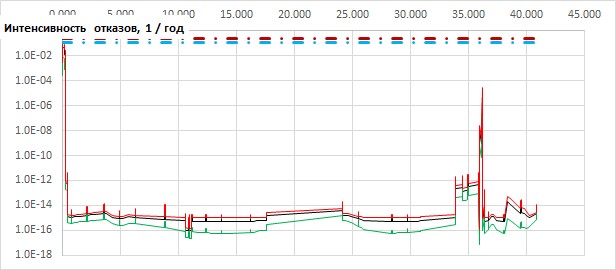
Figure 17 — Distribution of failure rate and the 90 % confidence band boundaries along the segment length
10.3 Environmental effect